We would love to hear about your Project
Get In Touch
Follow Us


Place & Property
|
Published on
September 23, 2026
|
updated last
November 10, 2026
|
5 MIN READ
Strategic Marketing Planning for Engineering Firms: Building a Brand That Drives Growth

Engineering firms don't need more marketing noise. They need a clearer strategy for growth.
Engineering businesses are built on technical expertise, complex problem-solving and the ability to deliver. Yet many struggle to communicate what makes them different, why their expertise matters and why clients should choose them over competitors.In a competitive market, technical capability alone is rarely enough to create meaningful differentiation.
The firms that stand out are those that connect their business strategy, brand positioning and marketing activity to a clear commercial ambition.
At TOAST, we believe marketing should never operate in isolation. It should be an extension of business strategy, built around a clear understanding of where a company wants to go, who it needs to influence and what makes it valuable.
For engineering firms, that means moving beyond reactive marketing and building a brand that supports business development, creates demand and positions the organisation for long-term growth.

What is strategic marketing planning for engineering firms?
Strategic marketing planning is the process of aligning an engineering firm's business objectives, market positioning, target audiences and marketing activity to support sustainable commercial growth. It defines where the business should compete, what it should be known for, who it needs to reach and how it will communicate its value.
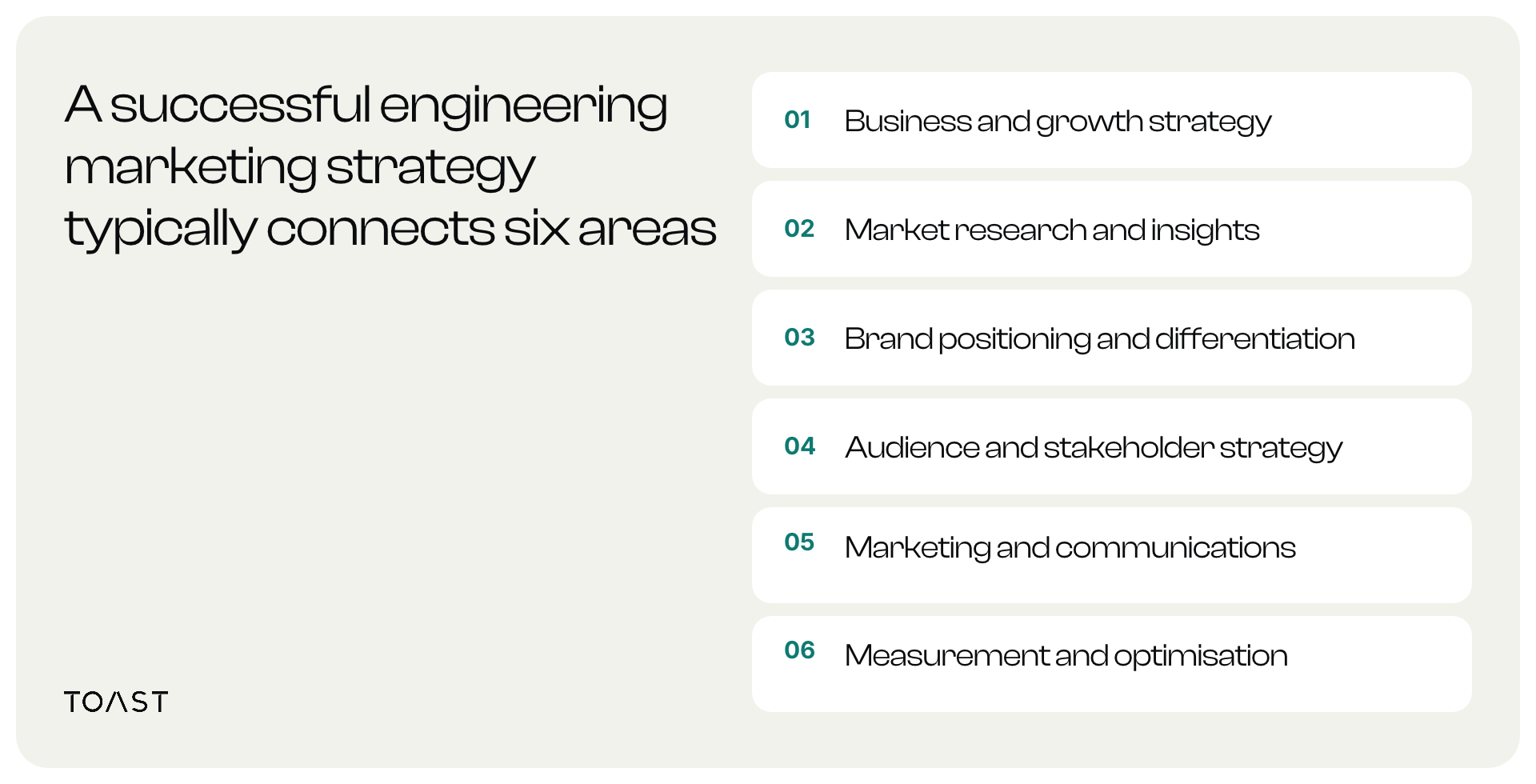
A successful engineering marketing strategy typically connects six areas:
- Business and growth strategy: Defining commercial ambitions, priority sectors and opportunities.
- Market research and insights: Understanding customers, competitors and the wider market.
- Brand positioning and differentiation: Establishing a clear, credible and distinctive market position.
- Audience and stakeholder strategy: Identifying decision-makers, their motivations and the challenges they face.
- Marketing and communications: Creating a connected approach across brand, digital, content and business development.
- Measurement and optimisation: Evaluating performance against meaningful business outcomes.
The objective isn't simply to generate more awareness. It's to build a stronger market position that creates the right opportunities and helps the business win more of the work it wants.
Why engineering firms need more than a marketing plan
Many engineering firms have grown through reputation, relationships, referrals and successful project delivery.
These are valuable foundations. But as businesses expand into new sectors, pursue larger contracts or compete against more established players, relying on reputation alone can limit growth.
Common challenges include:
- A strong technical offering but limited differentiation from competitors.
- An inconsistent brand story across divisions, services and locations.
- Marketing focused on completed projects rather than future opportunities.
- Websites and capability statements that communicate services but not commercial value.
- Business development and marketing teams operating without a shared strategy.
- Overreliance on tenders, referrals and existing relationships.
These are rarely just marketing problems.
They're often symptoms of a broader strategic challenge: the business hasn't clearly defined what it wants to be known for, who it wants to serve or why its approach matters.
The role of strategic marketing is to close the gap between business ambition and market perception.
1. Start with business strategy, not marketing tactics
Before discussing websites, LinkedIn, SEO or advertising, engineering firms need clarity on their commercial direction.
Where does the business want to be in three to five years? Which industries represent the greatest opportunity? Which services generate the strongest margins? What types of clients and projects best align with its capabilities?
These questions should shape the marketing strategy.
For example, an engineering consultancy looking to expand into renewable energy infrastructure requires a different positioning and go-to-market approach from a multidisciplinary firm focused on growing its government and defence portfolio. The first may need to establish credibility in an emerging market. The second may need to strengthen its reputation, demonstrate delivery capability and deepen relationships with existing stakeholders.
Our approach at TOAST begins by understanding the business before defining the brand.
Through discovery, stakeholder engagement, market research and strategic workshops, we uncover the commercial priorities, challenges and opportunities that should inform the direction.
The outcome is a clearer foundation for decision-making, ensuring marketing investment supports the future of the business rather than simply maintaining its current presence.
2. Build a brand position competitors can't easily claim
Engineering is a highly capable and often highly commoditised market.
Visit a collection of engineering websites and you'll find familiar language: innovative solutions, technical excellence, experienced teams and client-focused delivery. These qualities are important. But when everyone makes the same claims, they stop being meaningful points of difference.
Effective brand positioning answers three fundamental questions:
Who are we? Why do we matter? Why should clients choose us?
The answers need to be grounded in evidence, not marketing language. A firm's competitive advantage might come from its ability to navigate complex regulatory environments, integrate multiple disciplines, reduce delivery risk or solve problems other providers struggle to address.
The opportunity is to translate these strengths into a distinctive market position.
At TOAST, we approach brand positioning as a strategic business exercise, not a creative tagline exercise.
We examine the market, competitors, customers, culture and capabilities to identify a position that is relevant to buyers, credible for the business and difficult for competitors to replicate. From there, we build a brand narrative and messaging framework that communicates the firm's value consistently.
A strong brand doesn't simply describe what an engineering company does. It gives the market a compelling reason to choose it.

3. Understand the people who influence the buying decision
Engineering projects rarely involve a single decision-maker. Depending on the sector and project, buying groups may include engineers, project directors, procurement specialists, commercial managers, executives, government representatives and delivery partners.
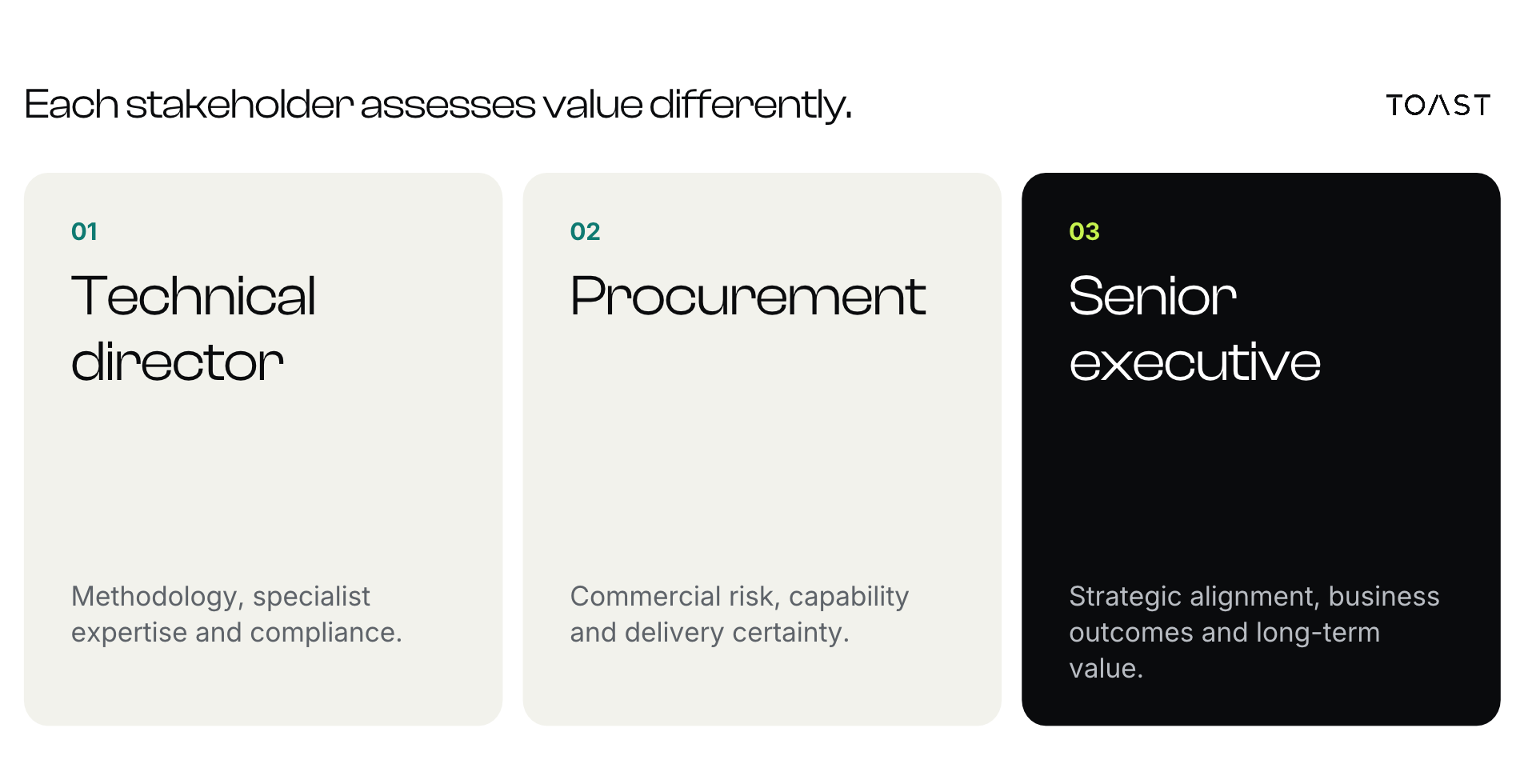
Each stakeholder assesses value differently. A technical director may prioritise methodology, specialist expertise and compliance. A procurement team may focus on commercial risk, capability and delivery certainty. A senior executive may be more interested in strategic alignment, business outcomes and long-term value.
An effective marketing strategy recognises these differences. Rather than communicating the same message to everyone, engineering firms need to understand:
- Who influences the purchasing decision?
- What business or technical problem are they trying to solve?
- What risks or barriers could prevent engagement?
- What evidence builds confidence?
- Where do they research, compare and evaluate potential partners?
This insight informs the brand narrative, website structure, service messaging, content strategy and business development materials. The goal is to make complex expertise relevant to the people making commercial decisions.
4. Turn technical capability into commercial value
Engineering firms are often excellent at explaining what they do. The bigger opportunity is communicating why it matters.
Clients don't simply buy engineering services. They invest in outcomes: reduced risk, greater efficiency, improved performance, regulatory confidence, delivery certainty and solutions to complex challenges.
This requires a shift from capability-led messaging to value-led communication.
For example:
Capability-led: We provide multidisciplinary engineering consultancy services across infrastructure projects.
Value-led: We bring engineering disciplines together to reduce project complexity, improve coordination and support more predictable infrastructure delivery.
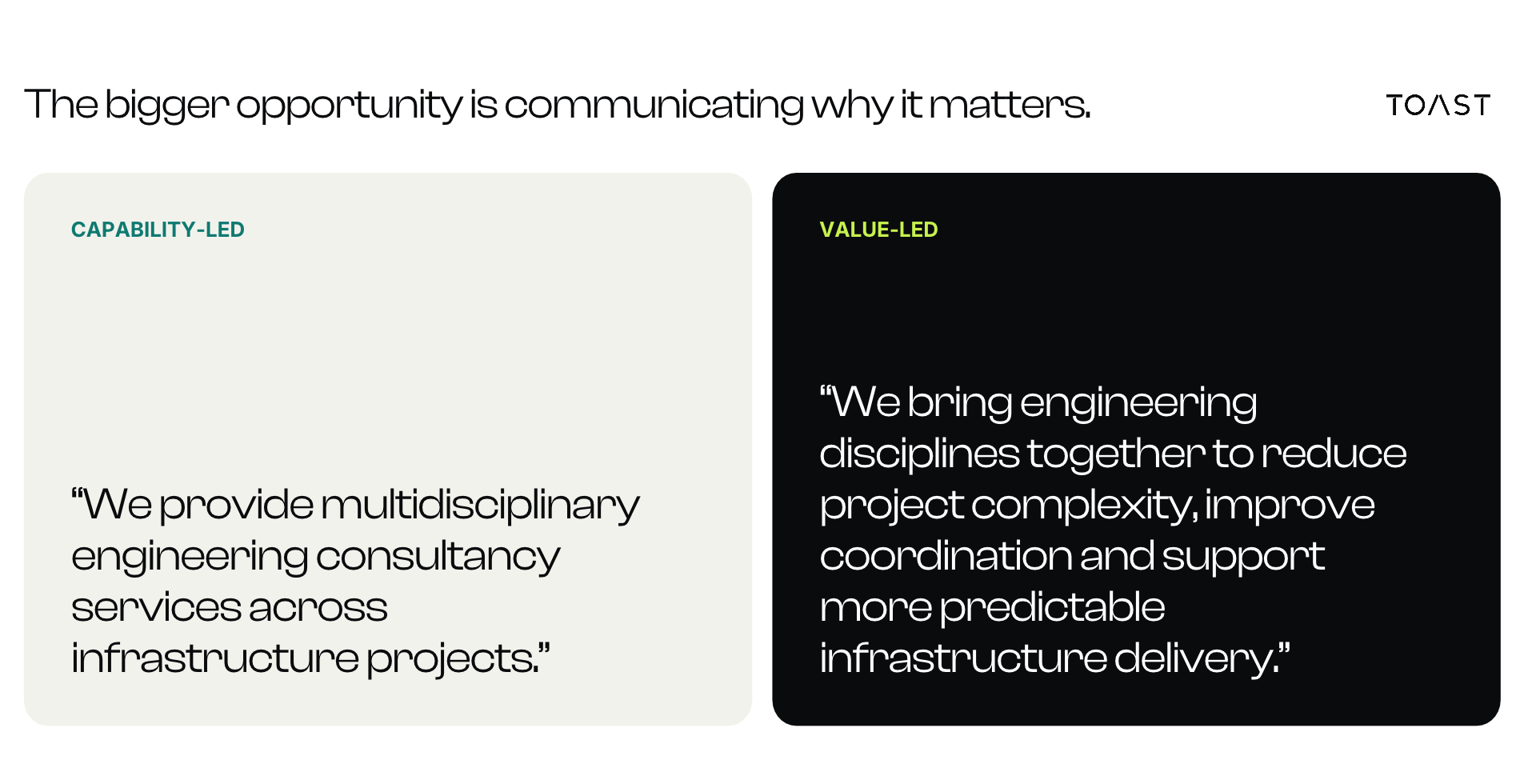
Both statements describe a capability, but the second makes the potential commercial benefit clearer. This principle should carry through every major brand touchpoint, including websites, capability statements, project case studies, credentials presentations, proposals and business development conversations.
Importantly, value-led communication should never overpromise. Strong claims need to be supported by credible evidence and real project experience.
The most effective engineering brands combine technical substance with commercial relevance.
5. Use project experience to build market authority
For engineering businesses, completed projects are among the most valuable marketing assets available.
But there's a difference between showcasing a project and demonstrating expertise. A project gallery may communicate scale and experience. A strategically developed case study demonstrates how the business thinks, solves problems and delivers value.
Strong engineering case studies should explain:
- The challenge: What problem did the client need to solve?
- The complexity: What technical, operational or commercial constraints were involved?
- The approach: How did the engineering team respond?
- The outcome: What was achieved and why did it matter?
- The evidence: What measurable results, client feedback or project details support the story?

Where client confidentiality permits, tangible results can make these stories considerably stronger.
Project experience can then be repurposed into industry insights, thought leadership, sector-specific landing pages, credentials material and business development content. This is particularly valuable in engineering, where trust and credibility are established over long buying cycles.
The objective is to move from simply showing completed work to demonstrating why your firm is the right partner for future work.
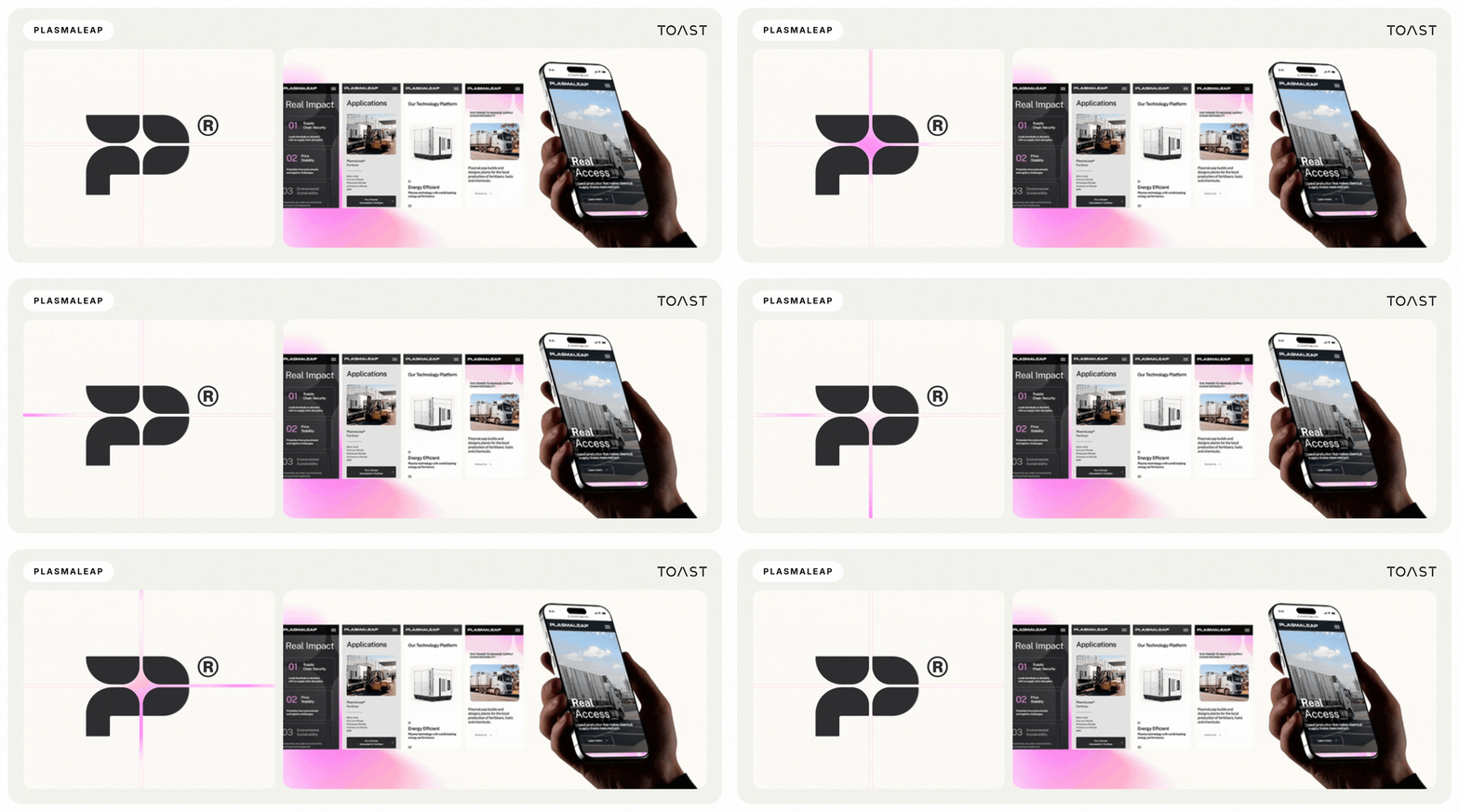
Case study: Plasmaleap

Case study: Virtos

Case study: Allshelter
6. Connect brand strategy with digital and marketing execution
Once the business has a clear strategic position, the next challenge is bringing it to market.
This is where many engineering marketing plans lose momentum. Brand strategy, website development, content, search, social media and business development are often treated as separate activities. Without a connected framework, the result can be inconsistent messaging, fragmented investment and limited accountability.
A more effective approach aligns every channel with a defined commercial purpose.
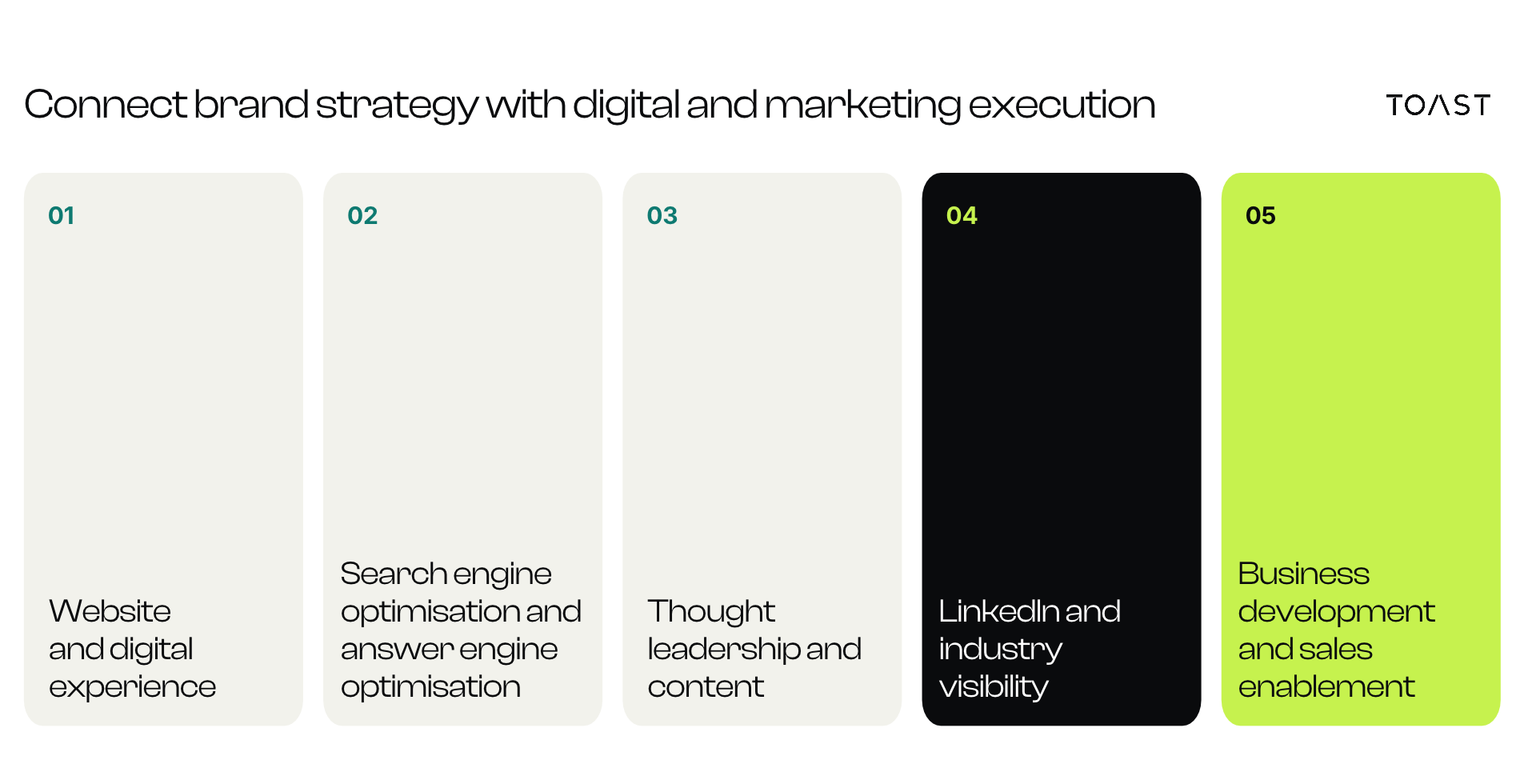
Website and digital experience
An engineering firm's website should function as more than a digital capability statement. It should clearly communicate the firm's positioning, explain its services, demonstrate relevant expertise and guide prospective clients towards meaningful engagement.
Website architecture should reflect how customers search for solutions and evaluate providers, rather than simply mirroring the firm's internal organisational structure.
Search engine optimisation and answer engine optimisation
Search remains an important way for prospective clients to discover and assess engineering providers. However, discovery is evolving as buyers increasingly use AI-powered tools, including ChatGPT, Claude, Perplexity and Google's AI search experiences, to research industries, understand capabilities and identify potential partners.
This creates an opportunity for engineering firms to develop authoritative, technically accurate and well-structured content that answers the questions their audiences are asking.
Effective SEO and AEO strategies should prioritise useful expertise, clear explanations, credible evidence and content that reflects genuine industry knowledge.
Thought leadership and content
Engineering firms have access to valuable intellectual capital through their technical teams, project experience and specialist knowledge.
A structured content strategy turns that expertise into market authority.Rather than publishing generic industry commentary, focus on the challenges clients face, emerging sector developments, technical considerations and practical insights that demonstrate the firm's perspective.
LinkedIn and industry visibility
LinkedIn, industry events, partnerships and professional networks can help strengthen reputation and build relationships before formal procurement begins.
For engineering firms, the most valuable content often comes from their people: directors, technical specialists, project leaders and subject-matter experts.
A connected strategy ensures this activity reinforces the same market position rather than creating disconnected messages.
Business development and sales enablement
Marketing should make business development more effective.
That means equipping teams with a consistent narrative, relevant sector credentials, compelling case studies, targeted content and materials that help move commercial conversations forward.
The result is a more integrated approach where brand, marketing and business development work towards the same growth objectives.
7. Measure marketing against commercial outcomes
Engineering marketing should be measured by its contribution to business growth, not simply the volume of activity produced.
Website traffic, impressions and social engagement can provide useful indicators of visibility, but they rarely tell the full story.
More meaningful measures may include:
- Growth in awareness and engagement within priority sectors.
- Enquiries and conversations with qualified prospective clients.
- Engagement from target accounts and decision-makers.
- Opportunities generated or influenced by marketing.
- Proposal conversion and project win rates.
- Growth in strategic sectors or higher-value services.
- Strength of the future project pipeline.
Not every result can be directly attributed to an individual marketing activity, particularly in complex B2B markets with long sales cycles.
The focus should be on understanding whether the business is becoming more visible, more relevant and more competitive in the markets it wants to serve.
Regular reviews between leadership, marketing and business development help maintain alignment and refine priorities as the market evolves.
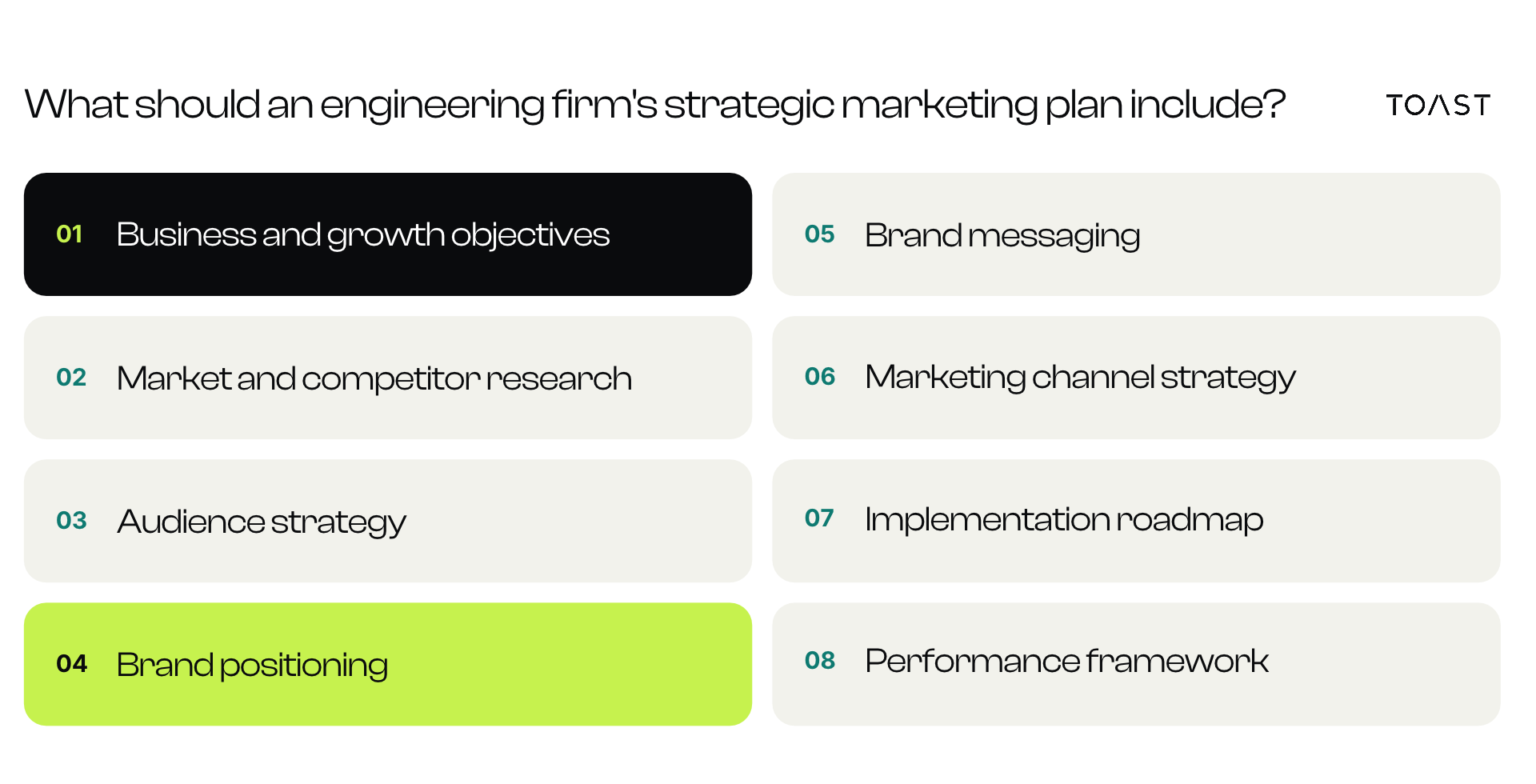
What should an engineering firm's strategic marketing plan include?
A practical strategic marketing plan should translate business ambition into a clear, actionable roadmap.
- Business and growth objectives: Agreed commercial priorities and target markets.
- Market and competitor research: Insight into opportunities, threats and competitive differentiation.
- Audience strategy: Clear understanding of priority clients and buying groups.
- Brand positioning: A distinctive market position and compelling value proposition.
- Brand messaging: Consistent narratives across services, sectors and stakeholders.
- Marketing channel strategy: Prioritised digital, content, search and relationship-building activity.
- Implementation roadmap: Defined initiatives, investment, responsibilities and timing.
- Performance framework: Measures connected to commercial objectives.
The level of detail will vary depending on the size, maturity and growth ambitions of the organisation.
What matters is that the plan is focused, achievable and supported by leadership.
How often should engineering firms review their marketing strategy?
Engineering firms should review marketing performance at least quarterly, with a more comprehensive strategic review annually or when significant business changes occur.
New market opportunities, acquisitions, service expansion, competitive pressures and shifts in customer demand can all influence the direction.
The underlying brand position should provide consistency, while marketing priorities and activities evolve in response to business needs.
A strong strategy creates direction without becoming rigid.
Why brand strategy is the foundation of sustainable growth
Marketing can generate attention. But without a clear market position, attention doesn't necessarily translate into preference.
For engineering firms, the real opportunity is to build a brand that reflects the strength of the business, communicates a compelling point of difference and creates confidence among the people who influence purchasing decisions.
When business strategy, brand positioning and marketing are aligned, the organisation is better equipped to enter new markets, attract higher-value opportunities, strengthen existing relationships and compete on more than price.
That's the difference between producing marketing activity and building a brand that supports commercial growth.
Partner with TOAST to build your next stage of growth
At TOAST, we're strategic brand makers for complex B2B businesses.
We work with ambitious organisations to connect business strategy, brand positioning, identity, digital experience and marketing into a clearer direction for growth. Our approach starts with understanding the business: its ambitions, customers, competitors, capabilities and the opportunities ahead.
From there, we help define a distinctive position and translate it into a connected brand and marketing experience that builds relevance, strengthens credibility and supports commercial performance.
For engineering firms navigating growth, diversification or increasing competition, the right strategy can change how the market understands and values the business.
Ready to build a brand that reflects where your business is going, not just where it's been?
Book a discovery call with TOAST.







TOAST acknowledges the Gadigal people of the Eora Nation, the traditional custodians of the land on which our agency stands. We celebrate the stories, culture and traditions of Aboriginal and Torres Strait Islander Elders of all communities who also work and live on this land.
