We would love to hear about your Project
Get In Touch
Follow Us


Brand & Engagement
|
Published on
November 4, 2026
|
updated last
November 10, 2026
|
5 MIN READ
7 Things to Know Before Hiring a Branding Agency
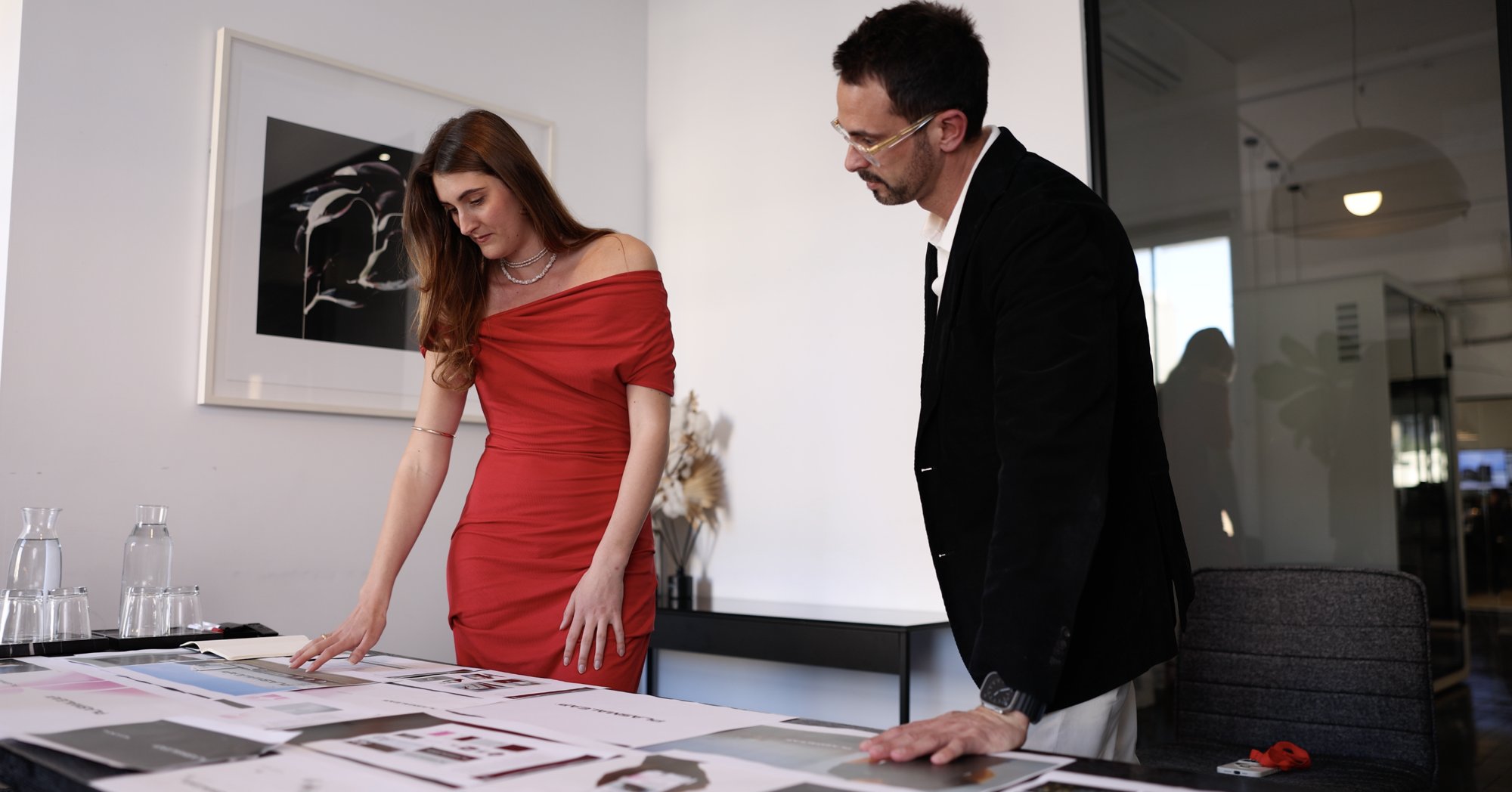
Choosing the right branding agency is about more than finding a team that creates great design. It's about finding a strategic partner that understands your business, challenges conventional thinking and builds a brand capable of driving meaningful growth.
Your brand is one of your most valuable business assets. It shapes how your organisation is perceived, what makes it different and why customers choose you over the competition.
But not all branding agencies approach the challenge in the same way.
Some focus on visual identity. Others specialise in strategy, positioning or creative execution. The strongest agencies connect these disciplines to create brands that are distinctive, commercially relevant and built for the future.
So, how do you choose the right branding agency?
Here are seven things every business should consider before making that decision.
1. Start with the business challenge, not the logo
Before engaging a branding agency, ask yourself one important question:
What does our brand need to achieve for our business?
Perhaps your business has evolved, but your brand hasn't kept pace. Maybe you're entering new markets, expanding your services or struggling to differentiate yourself from competitors.
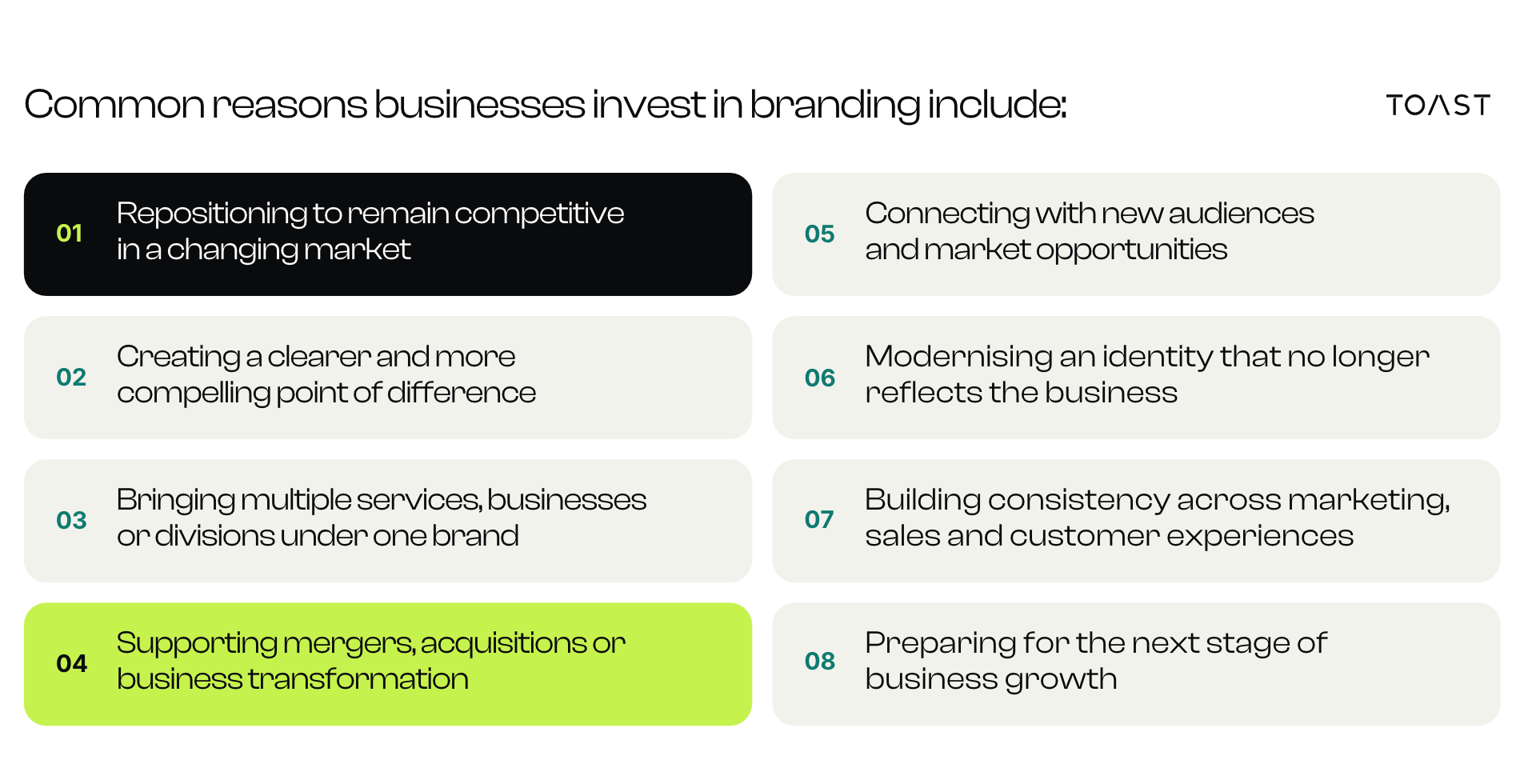
Common reasons businesses invest in branding include:
- Repositioning to remain competitive in a changing market
- Creating a clearer and more compelling point of difference
- Bringing multiple services, businesses or divisions under one brand
- Supporting mergers, acquisitions or business transformation
- Connecting with new audiences and market opportunities
- Modernising an identity that no longer reflects the business
- Building consistency across marketing, sales and customer experiences
- Preparing for the next stage of business growth
A great branding agency will look beyond the immediate brief to understand what's driving the need for change.
Because the most effective brand transformations don't start with design. They start with understanding the business.
2. Understand what you're actually buying: strategy, idea and identity
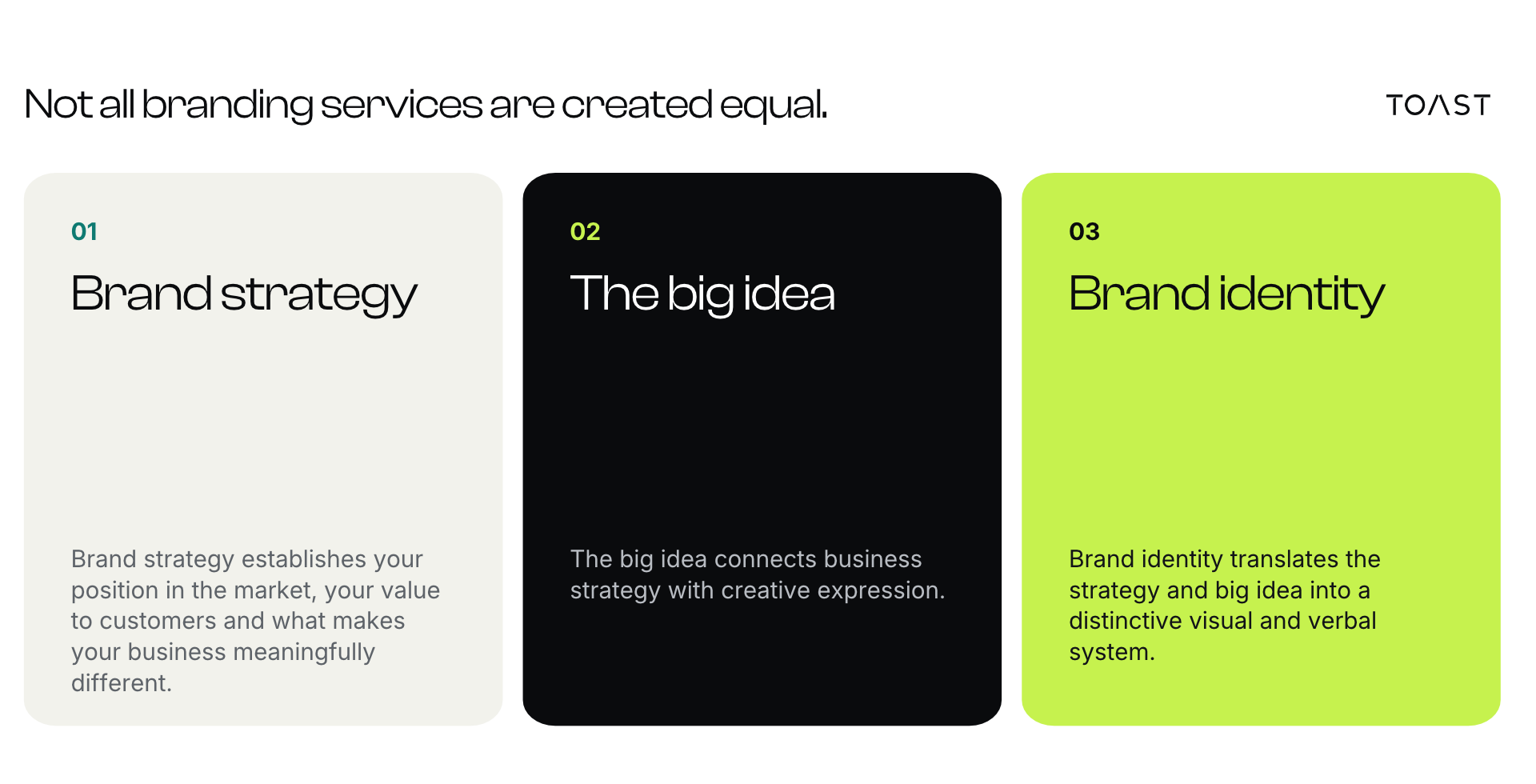
Not all branding services are created equal.
One of the most important distinctions when comparing agencies is understanding the relationship between brand strategy, the big idea and brand identity.
Brand strategy: The thinking behind the brand
Brand strategy establishes your position in the market, your value to customers and what makes your business meaningfully different.
It provides the strategic foundation for how your brand should behave, communicate and grow.
This typically includes research, audience insights, competitive analysis, brand positioning, purpose, value proposition, architecture and messaging.
The big idea: What makes your brand distinctive
A strong strategy needs a powerful creative idea to bring it to life.
The big idea connects business strategy with creative expression. It's the central thought that makes a brand memorable, relevant and recognisable.
It influences everything from messaging and visual identity to campaigns and customer experiences.
Brand identity: Bringing the idea to life
Brand identity translates the strategy and big idea into a distinctive visual and verbal system.
This can include your logo, typography, colour, imagery, tone of voice, digital design principles and brand guidelines.
The difference matters.
A beautiful identity without strategy may look impressive but fail to differentiate your business.
A strong strategy without a compelling creative idea may never connect emotionally with your audience.
And a great brand without consistent implementation can quickly lose its impact.
The right agency knows how to connect all three.
3. Look beyond the portfolio. Look at the thinking.
Every branding agency will show you its best work.
But a visually impressive portfolio doesn't necessarily tell you whether an agency can solve your business challenges.
Look for evidence of strategic thinking, creative originality and commercial understanding.
When reviewing branding case studies, ask:
- What challenge was the client facing?
- What insights informed the strategy?
- How did the agency identify the opportunity to differentiate?
- What was the big idea behind the creative?
- How did the new identity bring that idea to life?
- How was the brand implemented across the business?
- What outcomes did the project deliver?
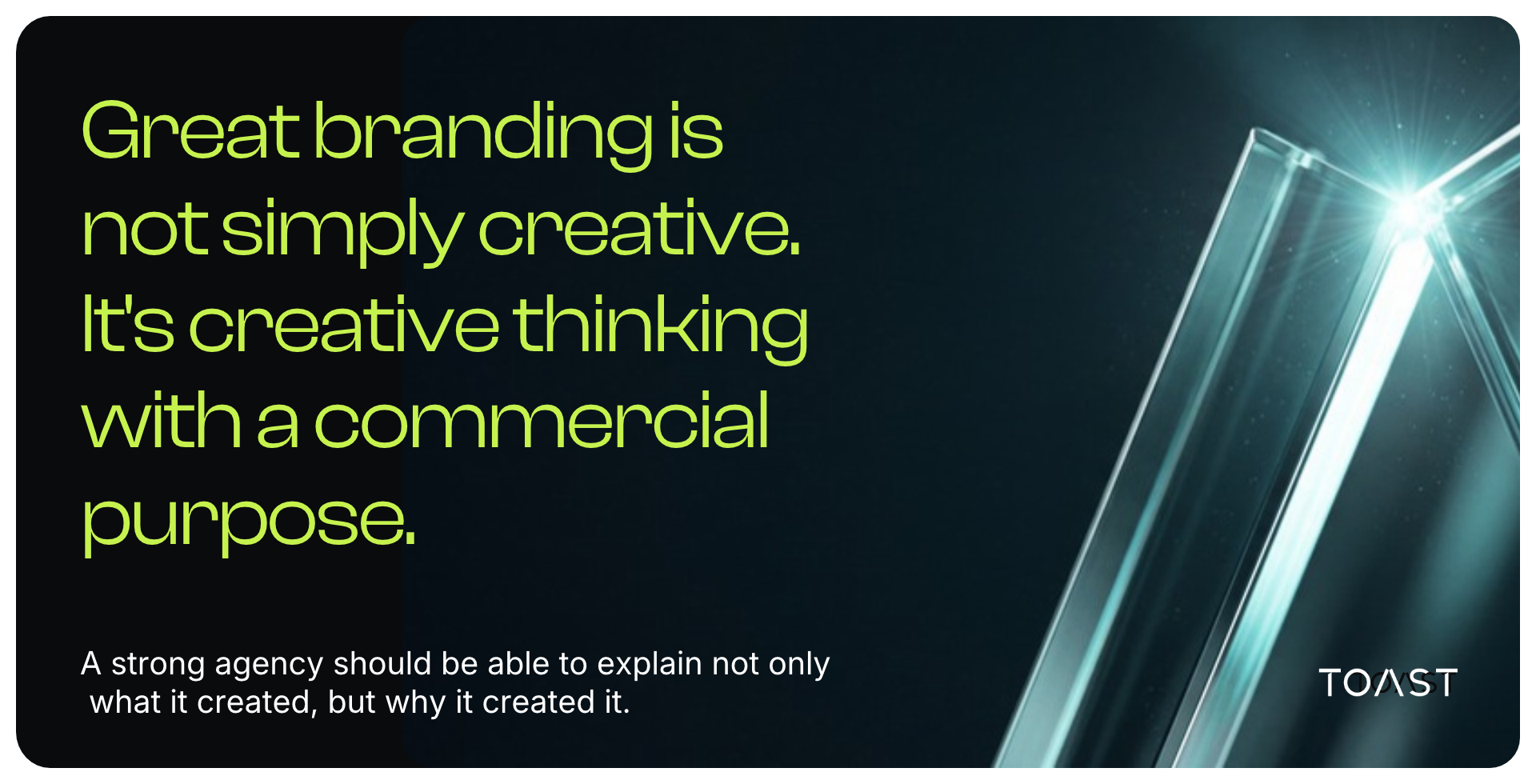
A strong agency should be able to explain not only what it created, but why it created it.
For B2B organisations and complex service businesses, this is particularly important.
The challenge is often less about making a business look better and more about making a complex offering easier to understand, more relevant and more compelling to the people who matter.
Great branding is not simply creative. It's creative thinking with a commercial purpose.
4. Choose an agency that understands your business, not just your industry
Industry experience can be valuable, but it shouldn't be the only deciding factor.
The right branding agency needs to understand how your business operates, what drives customer decisions and where the opportunities for growth exist.
This is particularly important for B2B businesses, where purchasing decisions can involve multiple stakeholders, complex services and longer sales cycles.
Your brand needs to communicate expertise, build trust and make your value immediately clear.
Look for an agency that can:
- Simplify complex products, services and business structures
- Identify meaningful competitive advantages
- Translate technical expertise into compelling customer value
- Align brand positioning with commercial objectives
- Develop clear messaging for different audiences
- Create consistency across sales, marketing and digital channels
- Build a brand that can evolve with the business
An agency shouldn't arrive with a predetermined answer.
It should bring the curiosity, strategic experience and creative thinking needed to uncover an opportunity you may not have recognised yourself.
The best brand partners don't just understand where your business is today. They help define where it could go next.
5. Compare the methodology and outcomes, not just the price
Branding proposals can vary considerably in scope, process and investment.
A lower-cost proposal may focus primarily on visual identity, while a more comprehensive brand transformation could include research, strategy, stakeholder engagement, creative development, design and implementation.
Before comparing fees, understand what's included and what the project is expected to deliver.
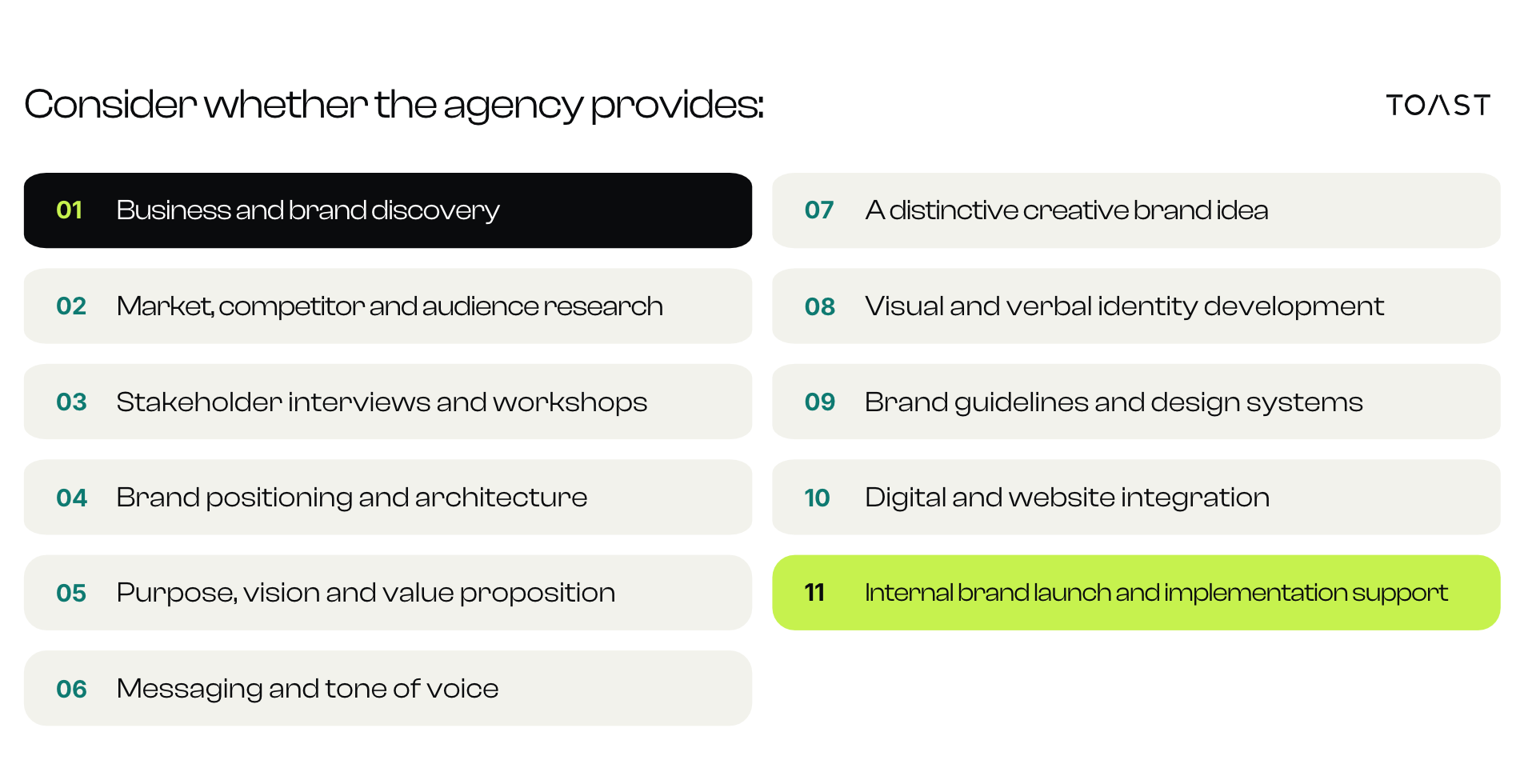
Consider whether the agency provides:
- Business and brand discovery
- Market, competitor and audience research
- Stakeholder interviews and workshops
- Brand positioning and architecture
- Purpose, vision and value proposition
- Messaging and tone of voice
- A distinctive creative brand idea
- Visual and verbal identity development
- Brand guidelines and design systems
- Digital and website integration
- Internal brand launch and implementation support
Just as importantly, understand how the agency moves from one stage to the next.
Why methodology matters
A structured branding process creates alignment, reduces subjective decision-making and ensures creative development is grounded in strategic insight.
At TOAST, we approach brand transformation through THE CHANGEMAKERS METHOD®, our five-stage process designed to turn business ambition into distinctive, future-ready brands.
Discover → Define → Big Idea → Design → Deliver
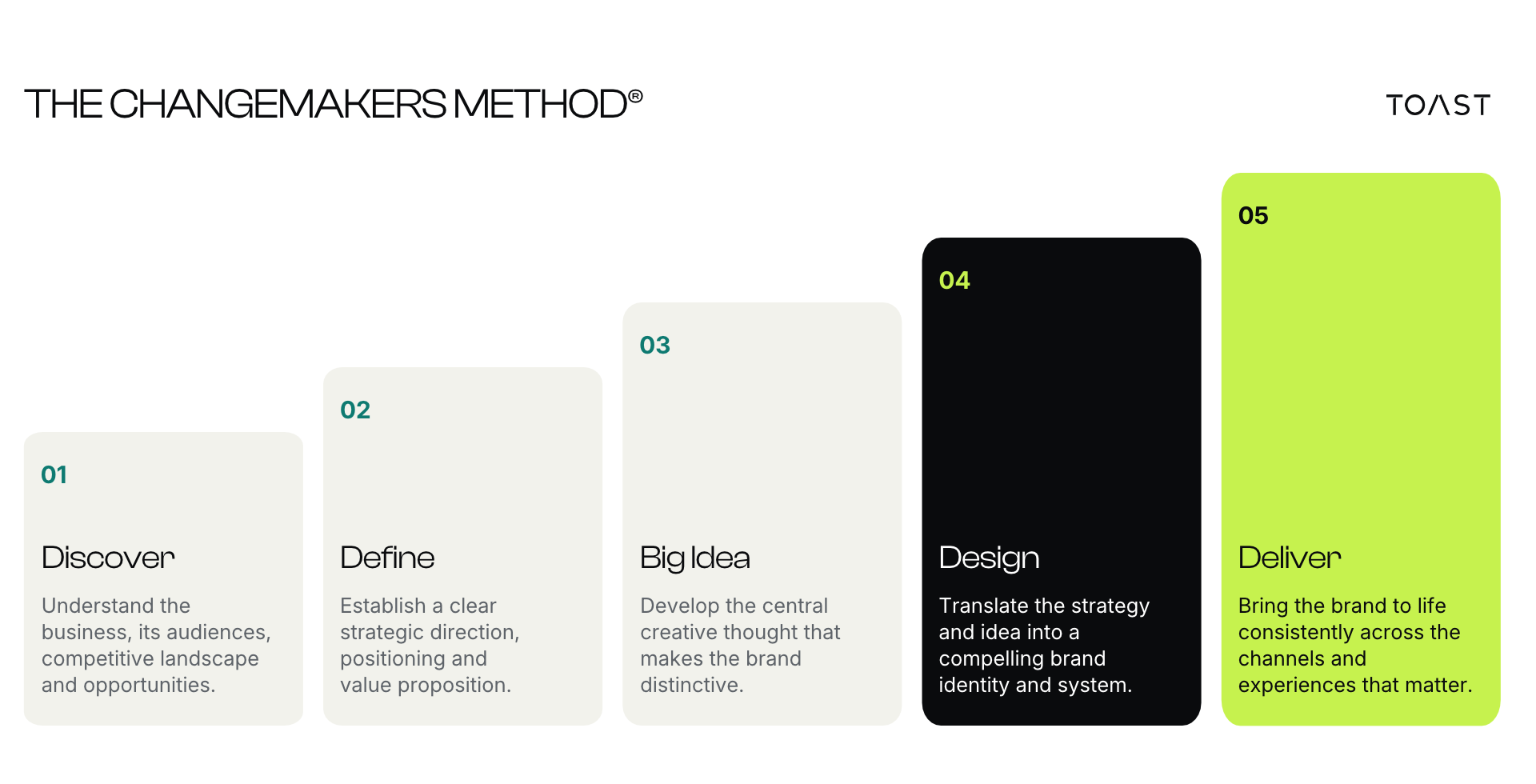
Discover: Understand the business, its audiences, competitive landscape and opportunities.
Define: Establish a clear strategic direction, positioning and value proposition.
Big Idea: Develop the central creative thought that makes the brand distinctive.
Design: Translate the strategy and idea into a compelling brand identity and system.
Deliver: Bring the brand to life consistently across the channels and experiences that matter.
Each stage informs the next, connecting strategic thinking with creative execution and practical implementation.
When evaluating agencies, don't simply ask which proposal is cheaper.
Ask which approach will create the greatest long-term value for your business.
6. Know who is actually creating your brand

A branding agency is only as strong as the people working on your business.
The team presenting the pitch isn't always the team delivering the project.
Before appointing an agency, understand who will be responsible for the strategic and creative decisions that shape your brand.
Ask:
- Who will lead the strategy?
- Who will develop the creative idea?
- How involved will senior strategists and creative directors be?
- Who will manage the project day to day?
- How will stakeholders be involved in key decisions?
- Will any of the work be outsourced?
- How will the agency manage feedback and approvals?
For growing and mid-sized businesses, access to experienced strategic and creative leadership can make a significant difference.
Brand transformation often involves challenging established thinking, navigating competing opinions and making important decisions about the future.
You need a team with the confidence and experience to guide that process.
You're not just investing in deliverables. You're investing in the people and thinking behind them.
7. Find a partner that challenges you to think bigger
The relationship between a business and its branding agency should be more than transactional.
A successful brand transformation requires collaboration, trust and a willingness to challenge assumptions.
The right agency will listen carefully, ask difficult questions and bring a perspective that pushes your business forward.
Look for a team that:
- Takes the time to understand your ambitions
- Challenges conventional thinking
- Connects creative recommendations to business objectives
- Communicates clearly and openly
- Manages stakeholder feedback constructively
- Brings fresh thinking rather than familiar solutions
- Balances creativity with commercial reality
- Is genuinely invested in the outcome
You don't need an agency that agrees with everything you say.
You need one that brings the strategic clarity, creative ambition and experience to help you make better decisions.
The strongest agency relationships don't just create better brands. They help create better businesses.
Frequently asked questions about hiring a branding agency
What should I look for when hiring a branding agency?
Look for an agency with proven strategic capabilities, distinctive creative work, a clear methodology and experience solving business challenges similar to yours. Assess the people involved, the scope of services and how the agency connects brand strategy with design and implementation.
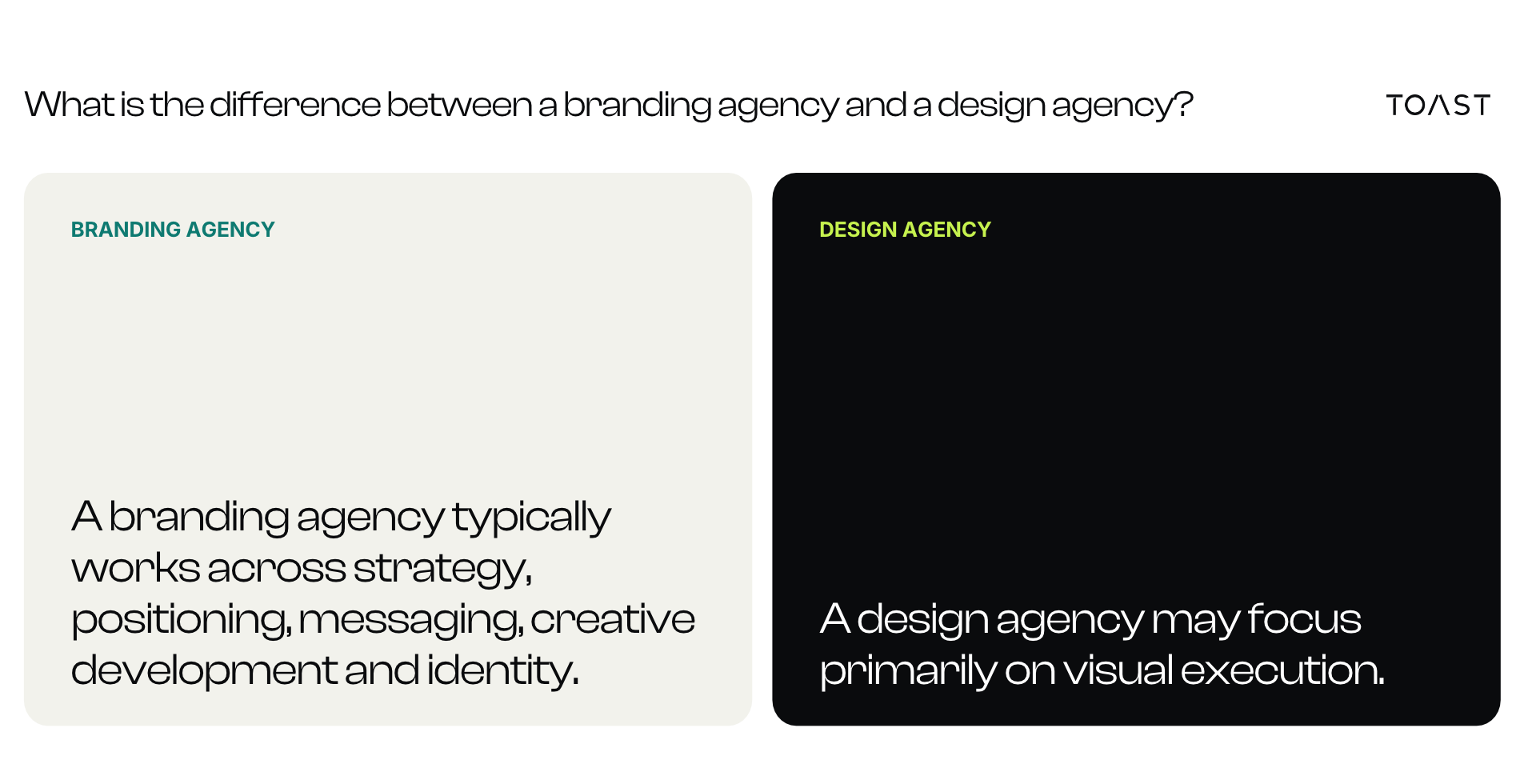
What is the difference between a branding agency and a design agency?
A branding agency typically works across strategy, positioning, messaging, creative development and identity. A design agency may focus primarily on visual execution. The distinction depends on the services each agency offers, so it's important to understand the scope before appointing a partner.
How much does it cost to hire a branding agency?
Branding costs vary depending on business complexity, research requirements, stakeholder involvement and the scope of creative and implementation work. A visual identity project may require a smaller investment than a comprehensive brand transformation involving strategy, architecture, messaging and rollout. The best approach is to request a clearly defined proposal based on your business objectives.
How long does a branding project take?
Timelines depend on the scope and complexity of the project. A focused identity refresh may take several weeks, while a comprehensive brand transformation can take several months. Research, stakeholder consultation, approvals and implementation requirements all influence the timeframe.
Should brand strategy come before logo design?
Yes. Brand strategy should establish your positioning, audience, value proposition and competitive differentiation before visual identity development begins. This gives the creative work a clear purpose and helps ensure the resulting brand supports your business objectives.
What questions should I ask before choosing a branding agency?
Ask how the agency approaches research, positioning, creative development and implementation. Find out who will work on your project, what's included in the scope, how stakeholders will be involved and how success will be measured.
How do you measure the success of a rebrand?
Success should be measured against the objectives established at the beginning of the project. Depending on the business, this may include brand awareness, audience perception, customer engagement, lead quality, conversion performance, employee alignment and overall commercial growth.
The right branding agency can change what's next
Choosing a branding agency isn't simply about finding someone to create a new identity.
It's about finding a partner that understands your ambition, sees the opportunities ahead and has the strategic and creative capability to help you realise them.
The right agency will challenge your thinking, clarify your position and build a brand that is distinctive, relevant and ready for the future.
Because a strong brand doesn't just change how your business looks.
It changes how your business is understood, experienced and chosen.
Make your next move count.
At TOAST®, we're strategic brand makers. We combine strategy, creativity and design to build the brands that make the future.
Whether you're repositioning, evolving or transforming your business, we can help define what comes next.
Let's talk about your brand.






TOAST acknowledges the Gadigal people of the Eora Nation, the traditional custodians of the land on which our agency stands. We celebrate the stories, culture and traditions of Aboriginal and Torres Strait Islander Elders of all communities who also work and live on this land.
